Home › Panels › Rockwool Roof
Class A1 Noncombustible · Load Bearing Profile

Rockwool Roof Panels
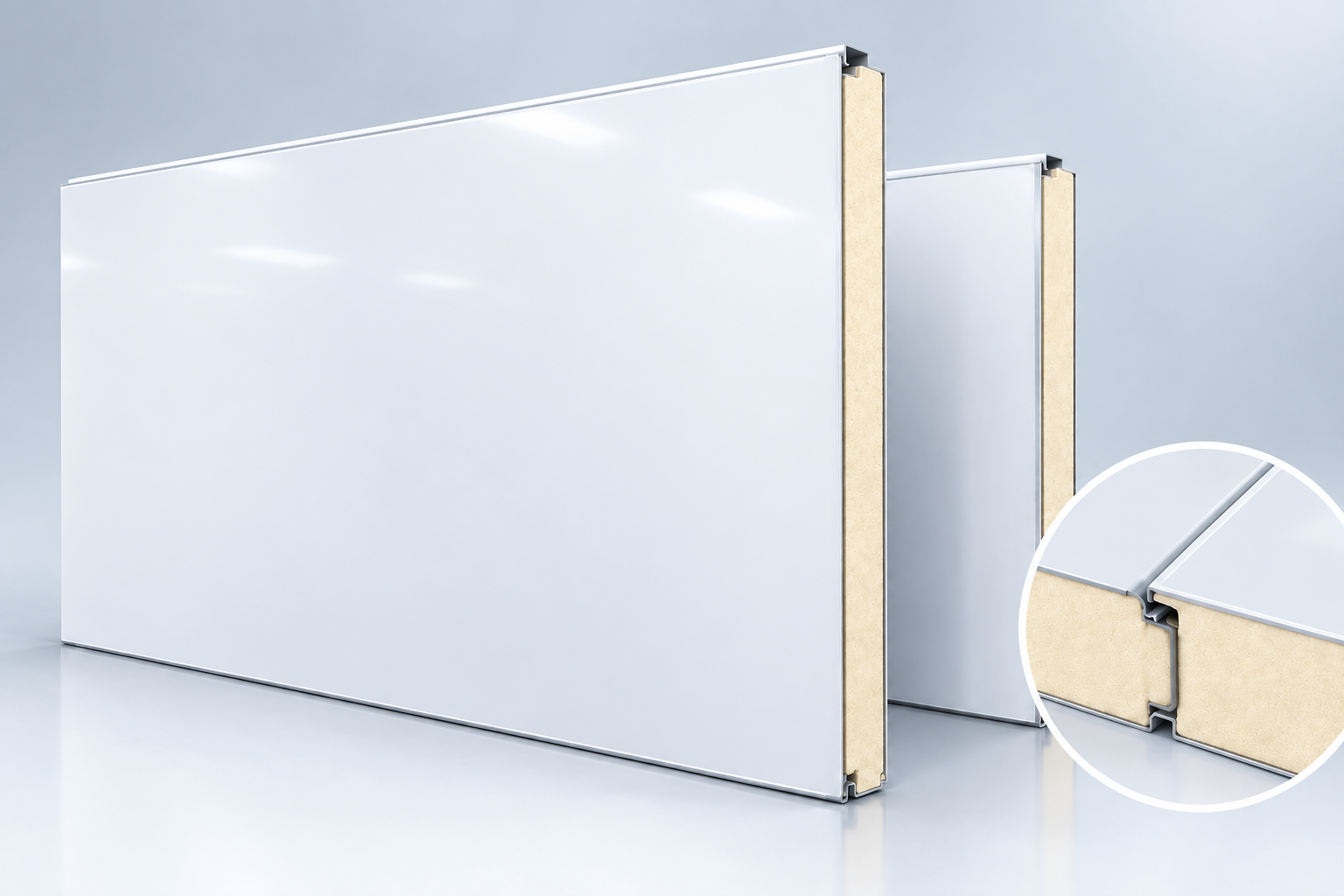
The roof panel that keeps its integrity in a fire and stays quiet in a storm. A deep trapezoidal steel top, a Class A1 mineral core with its fibres turned upright for load, and a sealed inner liner, all pressed on a continuous line for wide span industrial and commercial roofs.
◆ Class A1 Noncombustible
◆ Eurofins Fire Rated
◆ Rotated Fibre Lamellas
◆ EI30 to EI240
◆ Acoustic Rated
◆ Continuous Line Made
◆ Dimensionally Stable
◆ Pan India Delivery
◆ Class A1 Noncombustible
◆ Eurofins Fire Rated
◆ Rotated Fibre Lamellas
◆ EI30 to EI240
◆ Acoustic Rated
◆ Continuous Line Made
◆ Dimensionally Stable
◆ Pan India Delivery
◈

Class A1 Noncombustible

A mineral core that keeps its integrity past one thousand degrees, so the roof does not collapse early in a fire and people have time to get out.
◇

Carries Real Load

Trapezoidal ribs and upright fibres carry snow, wind uplift, maintenance foot traffic, and rooftop solar across wide spans.
◎

Quiet in the Rain

The dense mineral core absorbs the drum of heavy rain and hail that makes a bare metal roof so loud inside.
◻

Weather Tight

Overlapping high rib joints sealed with butyl, and single lengths up to twelve metres that cut out the leak prone end laps.

 
When Rockwool

When the Roof Cannot Be the Weak Point

Foam cored roof panels insulate well and weigh little, and for most buildings they are the right choice. But a foam core softens and decomposes as a fire grows, and a roof that loses its core loses its strength. A Rockwool roof does not. The mineral core holds its physical integrity past one thousand degrees, so the roof stays up long enough for people to evacuate and for crews to work safely beneath it. It is also far quieter in heavy rain. Specify Rockwool roofing where fire risk or noise governs, and foam where thermal performance and weight lead.
Property
Rockwool
PIR / PUF
Reaction to Fire
Class A1 noncombustible
Class B, standard
Fire Resistance
EI30 to EI240
Limited
Core Melting Point
Over 1000°C
Softens and drips
Acoustic (Rw)
Up to 35 dB
Lower
Thermal Conductivity
0.038 to 0.044 W/mK
0.022 to 0.024 W/mK
Core Density
100 to 120 kg/m³
40 to 48 kg/m³
Best Default For
Fire and acoustic
Thermal and cold storage
How It Is Built

Engineered on a Continuous Line

A continuous line Rockwool roof panel earns its strength and its weather tightness from how the core is turned and how the joint is formed, not from the core alone. These are the features that let it span wide and stay sealed on a low pitch roof.
01

Trapezoidal Load Ribs

Deep trapezoidal crests rolled into the outer sheet give the panel its rigidity, so it spans wider between purlins while carrying snow load, wind uplift, foot traffic, and rooftop solar.
02

Rotated Fibre Lamellas

The mineral core is cut into strips and turned ninety degrees so the fibres stand upright, which stops the panel crushing under foot traffic or snow and gives it real shear strength.
03

Overlapping High Rib Joint

Adjacent panels overlap along the high outer crest, sealed with factory applied butyl and a secondary weather gasket, so water cannot draw back into the joint in torrential rain or melting snow.
04

Single Length Panels

Cut to length up to twelve metres and beyond, long panels cut out the transverse end laps that are the usual source of leaks on a low pitch roof.
A1
Reaction to Fire
EI30 to EI240
Fire Resistance
Over 1000°C
Panel Construction
12 m +
Single Panel Length

PANEL JOINERY

Available Joint Systems

Roof Joint

Single Tongue And Groove

Double Tongue And Groove

Hidden Tongue And Groove

M - Section

Surface Materials

Facing Options

PPGI

Pre-Painted Galvanised

0.30 to 0.80mm. SMP, RMP, PVDF coatings.
PPGL

Pre-Painted Galvalume

Superior corrosion resistance. Coastal environments.

AL

Aluminium

0.40 to 0.71mm. Lightweight, non-magnetic.
PPAL

Pre-Painted Aluminium

Custom RAL colours. Clean room and architectural.

SS

Stainless Steel

SS304, SS316. GMP pharmaceutical. 0.50 to 1.20mm.

Interactive Tool

Configure Your Panel

Select your application below.
The recommended specification updates automatically.

Select Your Application
01
Fire-Risk Industrial
Flammable materials, chemical zones
→
02
Adjacent Buildings
Fire spread prevention roofing
→
03
Maximum Fire Roof
Highest Class A1 roofing spec
→
04
Insurance-Mandated
Insurer requires non-combustible
→
05
Quiet Roof
Rain noise + fire in one panel
→
Recommended Specification
Fire-Risk Industrial Roof
Recommended
Thickness
80 to 120mm
Facing
PPGI Profiled
Joint
Tongue & Groove
Temperature
All Ranges
Fire Rating
Class A1 · 2-HR
U-Value
≤ 0.48 W/m²K
◆Non-combustible roofing for buildings storing or processing flammable materials
◆Stops fire spreading across the roof surface, preventing total building loss
◆Profiled exterior provides weatherproofing and structural stiffness
◆Compatible with all ACE Pre-Engineered Building rafter and purlin systems

Before You Order

Specification Checklist

Most specification mistakes happen early. Wrong thickness for the temperature delta. Wrong fire class for the occupancy type. Wrong coating grade for the site conditions. Use this checklist before you freeze your bill of quantities.

What to Lock Before You Order

After Installation

Where It Goes

Applications

High Risk Industrial

Foundries, chemical storage, recycling, and hazardous manufacturing where fire prevention is strict.

Noise Sensitive Buildings

Auditoriums, arenas, schools, and offices near airports or busy transit corridors.

Logistics & Warehousing

Large distribution hubs where the building code requires A1 noncombustible roofing to lower premiums.

Solar Ready Roofs

Roofs carrying rooftop solar, where a load bearing profile and a noncombustible core matter together.

Questions

Before You Specify

What specifiers, fire officers, and contractors ask us most about Rockwool panels.
Yes, noticeably. A bare metal roof drums loudly under heavy rain and hail. The dense mineral core absorbs that impact energy, so the space below stays far quieter, which is exactly why Rockwool roofing suits auditoriums, schools, and offices near flight paths.
Yes. The trapezoidal ribs give the panel its spanning strength and the upright fibres stop the core crushing, so the roof carries maintenance foot traffic, snow load, wind uplift, and rooftop solar, within the span and load we confirm for your building.
The panels overlap on the high rib, the strongest and highest point, sealed with factory applied butyl and a weather gasket, so water cannot draw back into the joint. Single lengths up to twelve metres also remove the transverse end laps that cause most low pitch roof leaks.
Because a foam core softens and decomposes as a fire grows, while Rockwool holds its integrity past one thousand degrees. On a high risk building that is the difference between a roof that stays up long enough to evacuate and one that does not, and it is often what the fire code and the insurer require.
The panels are Class A1 noncombustible and provide fire resistance from EI30 up to EI240 depending on build up, backed by Eurofins certification. We provide the certificate for your tender or compliance file on request.
OUR PRODUCTS

Explore Related Products

Rockwool Wall

The same noncombustible core, for facades and fire walls.

PIR/PUF Roof Panels

Better thermal and lighter, where fire is not the governing concern.

Fire Insulation

How Rockwool protects a building and buys time in a fire.

Industrial Sheds

The buildings our Rockwool roofs most often cover.

Talk to Our Team

Roofing a High Risk Site?

Tell us the span, the load, and what sits below, and our team will come back with a Rockwool roofing specification, a price, and a timeline within five working days.