Home › Panels › Rockwool Wall
Rockwool Wall Panels
Class A1 Noncombustible
Rotated Fibre Strength
Serious Acoustic Barrier
A dense fibrous core that absorbs sound, cutting airborne noise with Rw ratings up to thirty five decibels.
Holds Its Shape
Not batch produced. The same density and performance on every panel off the press.
When Rockwool
When Fire Is the Deciding Factor
Engineered on a Continuous Line
Rotated Fibre Lamellas
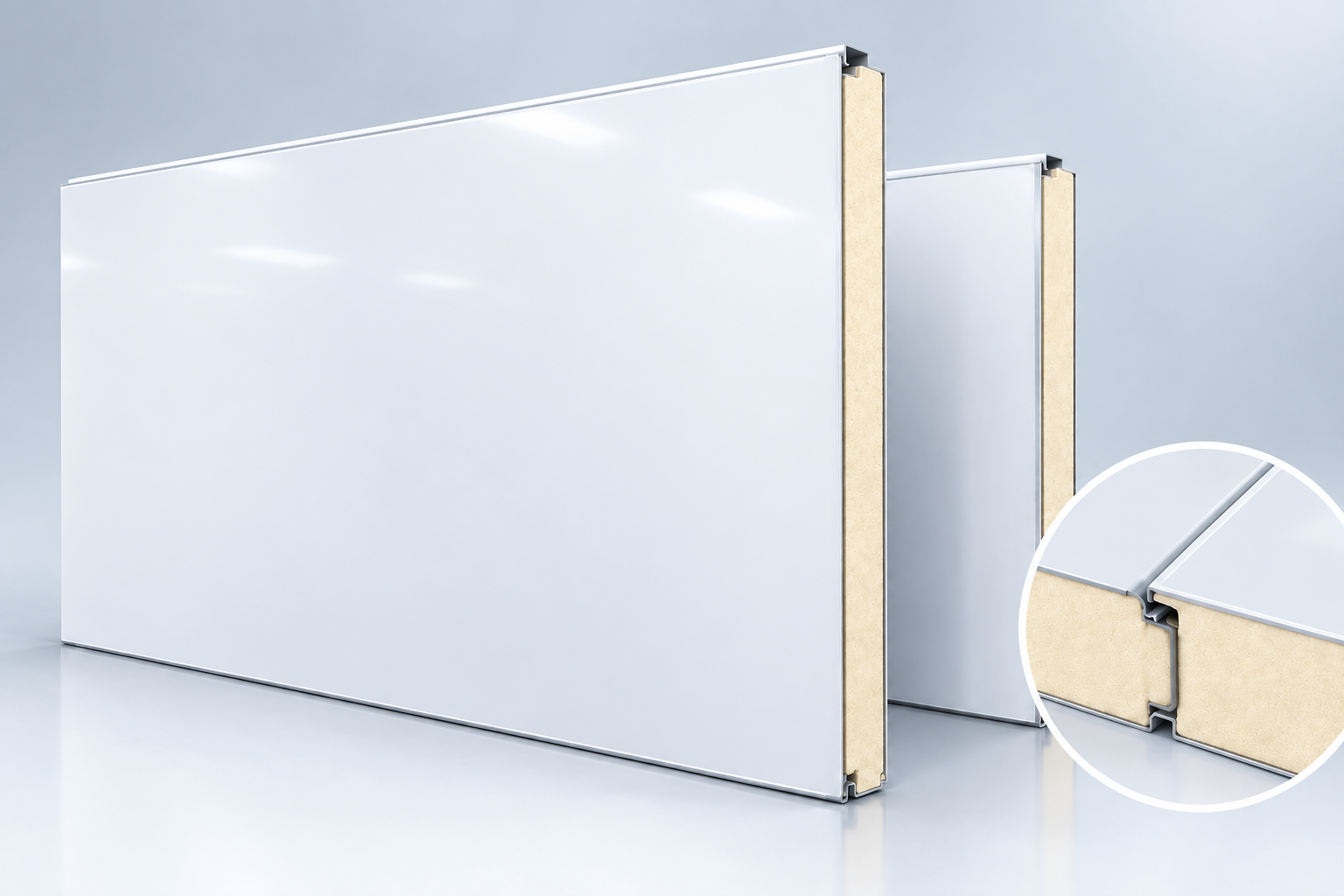
The mineral wool is cut into strips and turned ninety degrees so the fibres stand upright between the two steel skins. That vertical grain is what gives the panel its compressive strength, its shear stiffness, and its resistance to wind suction across a tall facade.
Tight Interlocking Joints
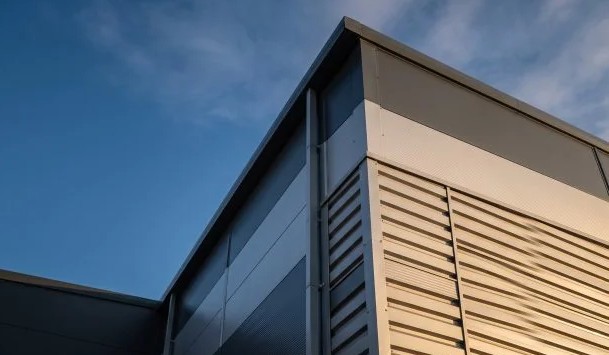
Continuous roll forming presses a precise interlocking edge profile into every panel, so they lock together into a continuous, airtight, weather resistant wall with no visible gaps across long spans.
Single Length Panels
An integrated flying saw cuts the running panel to the exact length you need, up to twelve to fifteen metres and beyond, so a wall can go up in one vertical span with no horizontal joints to seal or fail.
Optional PU or PIR Edge
On premium panels a polyurethane or PIR strip is injected along the joint edges, protecting the mineral core from moisture and closing the thermal path at every joint.
PANEL JOINERY
Available Joint Systems
Roof Joint
Single Tongue And Groove
Double Tongue And Groove
Hidden Tongue And Groove
M - Section
Surface Materials
Facing Options

PPGI
0.30 to 0.80mm. SMP, RMP, PVDF coatings.
PPGL
Pre-Painted Galvalume
Superior corrosion resistance. Coastal environments.

AL
Aluminium
0.40 to 0.71mm. Lightweight, non-magnetic.

PPAL
Pre-Painted Aluminium
Custom RAL colours. Clean room and architectural.

SS
Stainless Steel
SS304, SS316. GMP pharmaceutical. 0.50 to 1.20mm.
Interactive Tool
Configure Your Panel
Select your application below.
The recommended specification updates automatically.
Before You Order
Specification Checklist
Most specification mistakes happen early. Wrong thickness for the temperature delta. Wrong fire class for the occupancy type. Wrong coating grade for the site conditions. Use this checklist before you freeze your bill of quantities.
What to Lock Before You Order
- Rockwool has a higher thermal conductivity than PIR (0.038 vs 0.022 W/m·K). You will need thicker panels to achieve the same U-value. Factor this into your wall thickness and floor area calculations.
- Rockwool panels are heavier than foam-core alternatives. Verify your structural steel is designed for the higher cladding weight before ordering.
- Get your fire engineer and insurer to confirm Class A1 is the required specification. If Class B (PIR) would satisfy the requirement, you may save cost without compromising compliance.
- Rockwool absorbs moisture. It is not ideal for cold storage or high-humidity environments where condensation is likely. Specify PIR for those applications.
- Request the Eurofins fire test certificate with your quotation. Confirm the fire rating applies to the specific thickness and facing combination you are ordering.
After Installation
- Walk all joint lines and flashings after every monsoon season. Sealant failure is the most common leak path.
- Clean panel surfaces with mild detergent only. Abrasive cleaners cut through the coating and shorten its life.
- Re-check fastener torque every two years on exposed roofing panels.
Where It Goes
Built for
Fire and Sound
Fire Separation Walls
Internal partitions that divide warehouses, logistics centres, and chemical plants into separate fire compartments and lower the insurance risk.
High Acoustic Buildings
Power plants, compressor enclosures, manufacturing halls, and auditoriums that need serious noise control inside or out.
Commercial Facades
Shopping centres, sports arenas, transport hubs, and schools where the fire code demands A1 noncombustible cladding.
Clean Rooms & High Care
Pharmaceutical, electronics, and food spaces that need a noncombustible wall with a smooth, easy to clean surface.
Questions
Before You Specify
What does Class A1 actually mean?
What fire resistance rating can a Rockwool wall reach?
How good is the acoustic performance?
Are Rockwool panels heavier than PIR or PUF?
When should I choose Rockwool instead of PIR or PUF?
Choose Rockwool when the wall itself must not burn, when a fire compartment or boundary wall is required, or when acoustics matter. Choose PIR or PUF when thermal performance, thinner walls, and lighter weight matter more and fire is not the governing concern.
Explore Related Products
Talk to Our Team
Specifying a Fire Wall?
- Factory: Derabassi, Mohali, Punjab
- Office: #669, Sector 11-B, Chandigarh
- Phone: +91 98883 00888
- Email: info@aceprefab.com