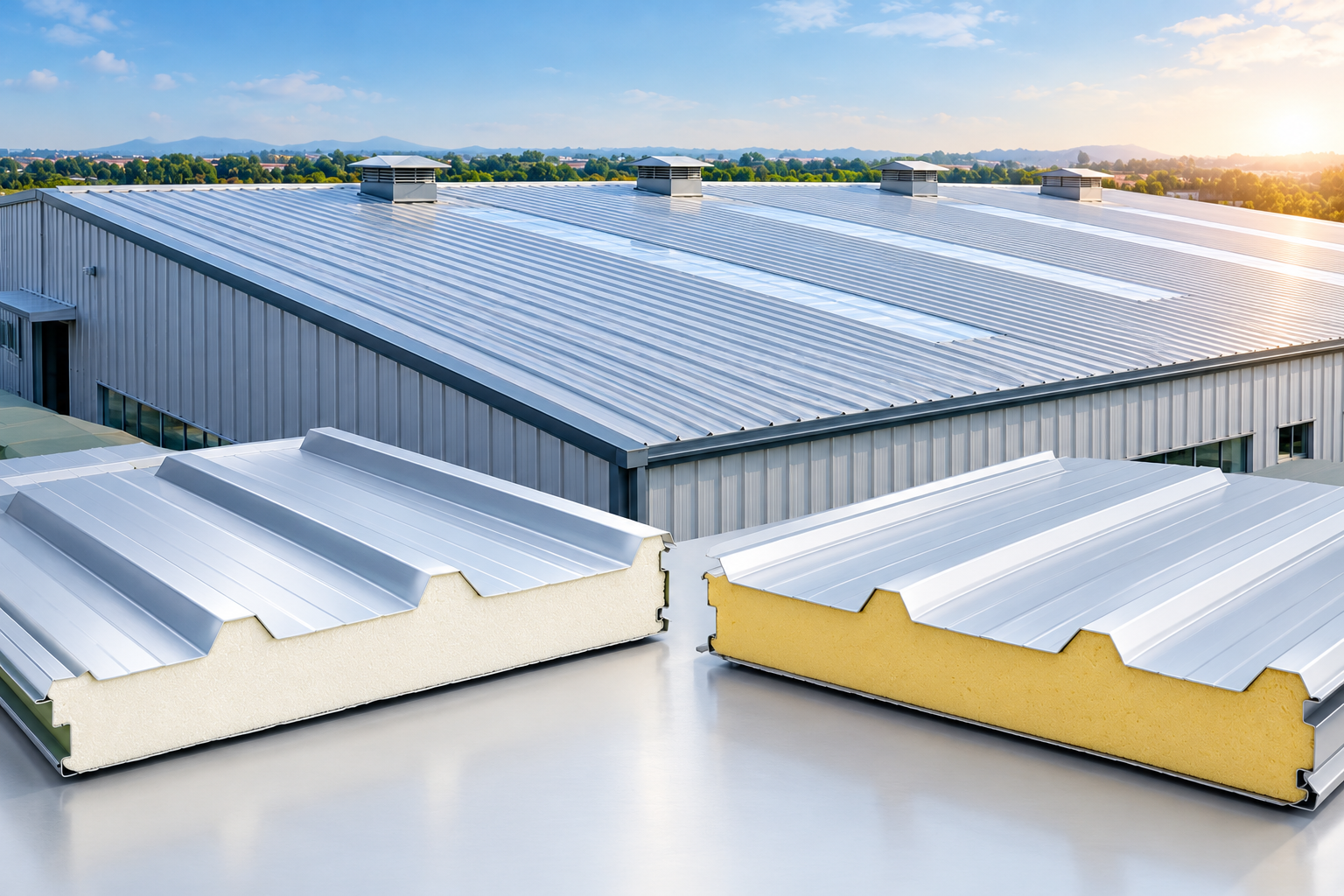
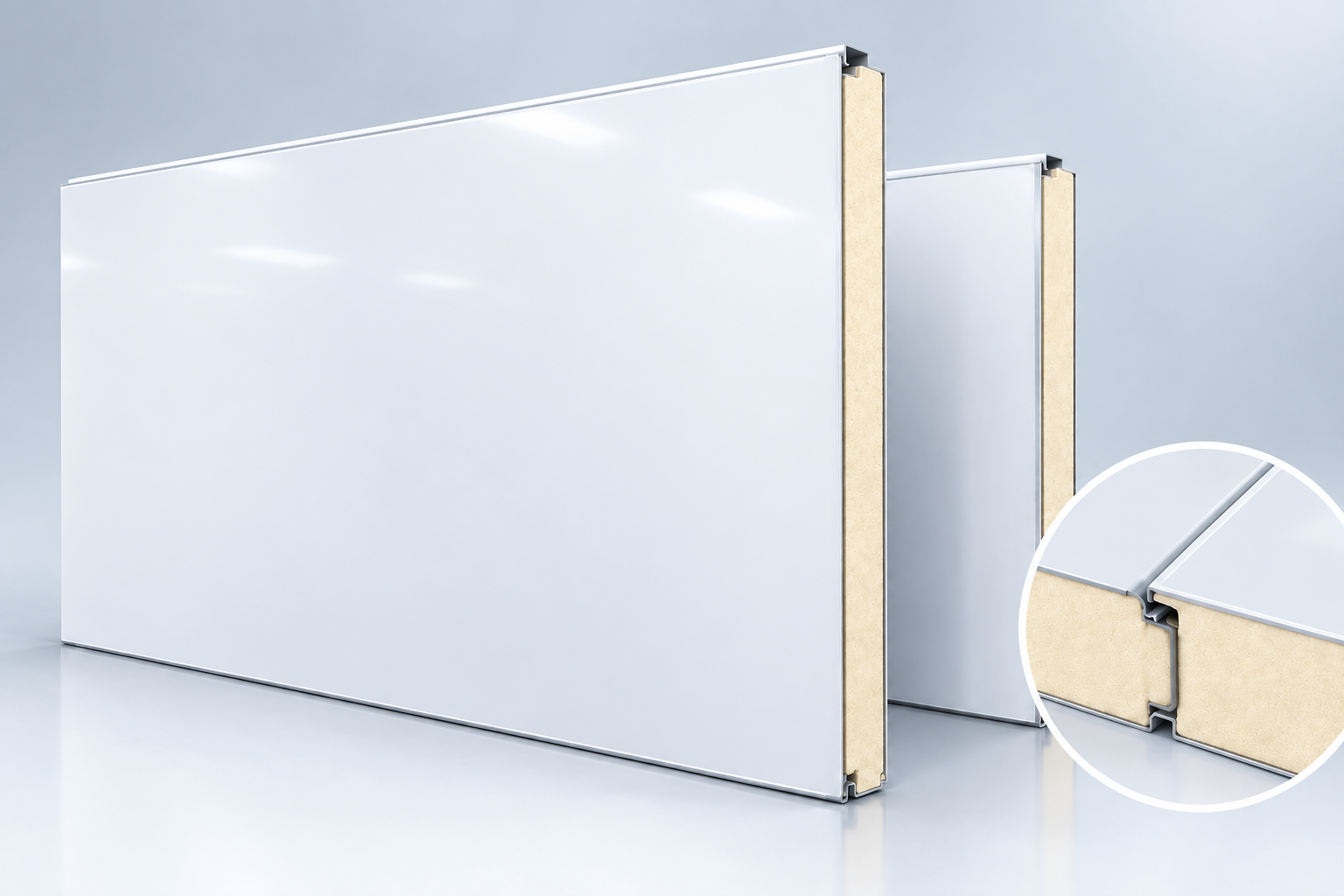
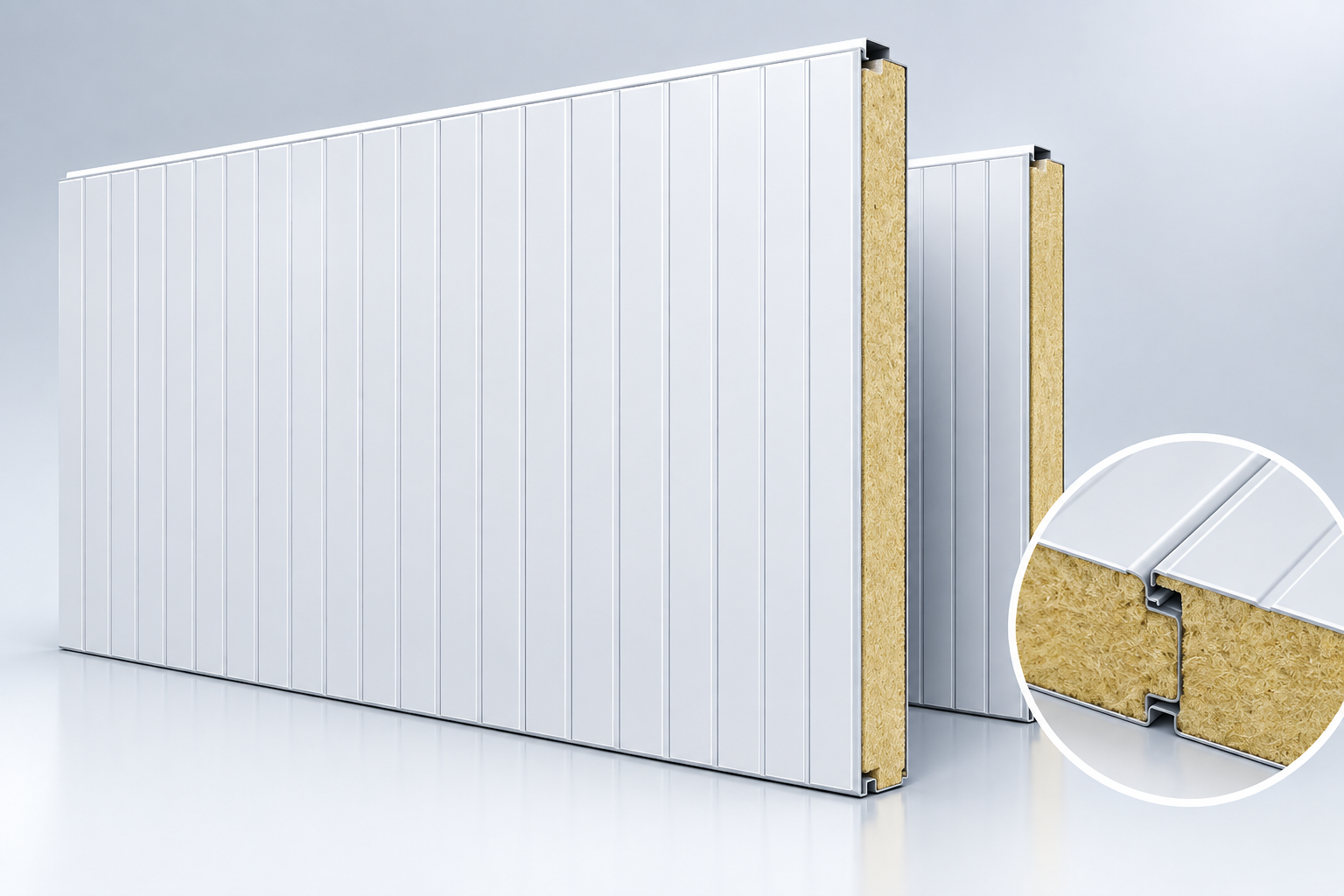
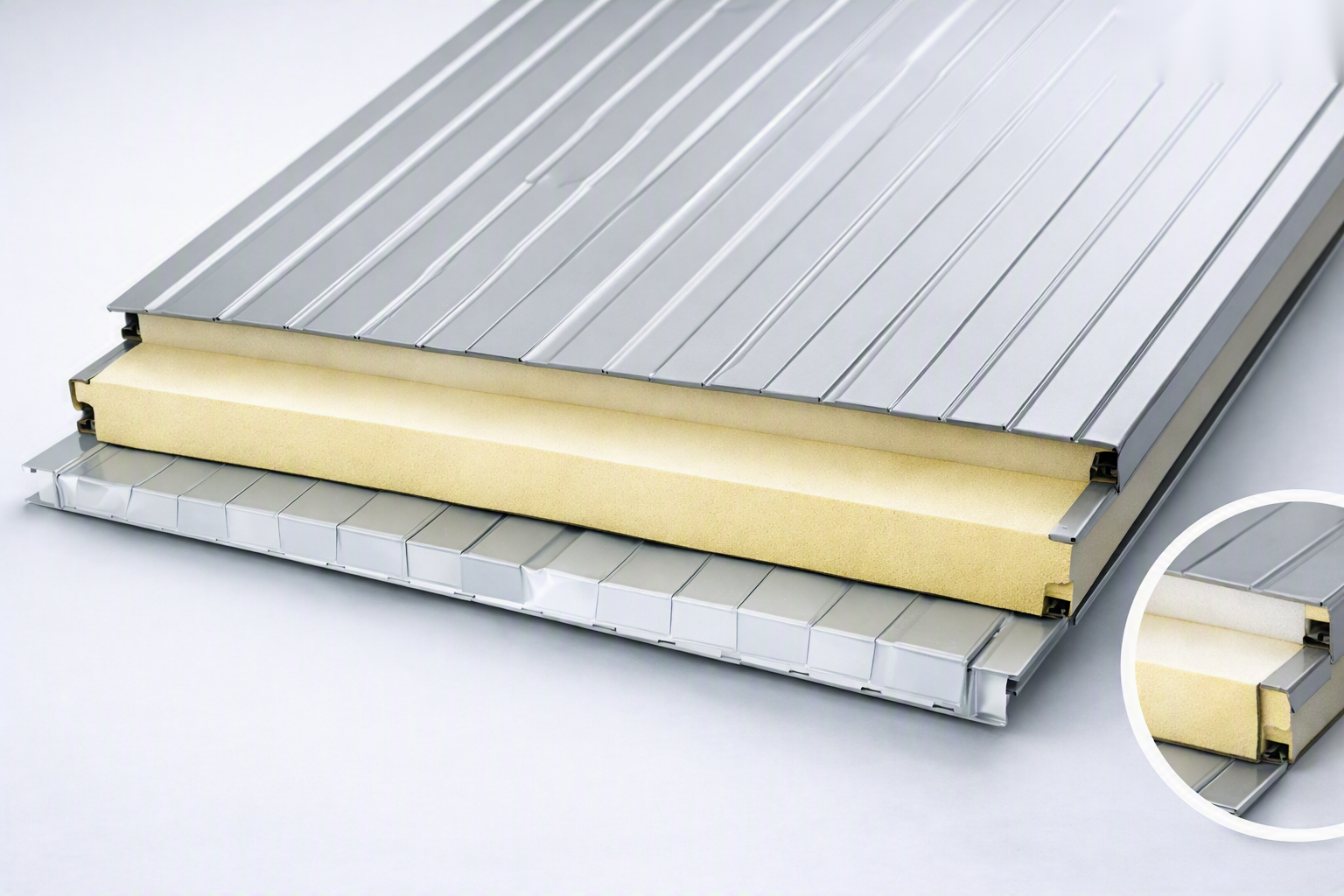
The insulated roof panel in one decision. PIR by default for the lowest thermal loss where it matters most, at the roof, and PUF where the budget leads and the temperature allows. Both carry a profiled, weather sealed top and span between purlins without a mid support in most bays, pressed on the same continuous line at Derabassi.
We fit PIR as standard for the lowest thermal loss at the roof, with PUF ready when budget leads.
◇
Built to Span
Profiled panels span between purlins without a mid support in most bays, so the roof goes on fast.
◎
Weather Sealed
A profiled, overlapping top engineered to shed water and lock out leaks for the life of the roof.
◻
Eurofins Fire Rated
Independently certified fire performance, with lower smoke than a standard foam panel.
One Core Family
PIR & PUF,
One Choice to Make
A roof is where a cold facility loses the most energy, so the core you put overhead matters more than anywhere else. PIR and PUF come off the same chemical family and we make both on the same continuous line, which is why we treat the roof as one decision. PIR is the core we fit by default, for its lower thermal loss and better fire behaviour. PUF remains the sensible, lower cost choice for roofs over spaces that hold above minus twenty degrees. The table shows where each one earns its place.
See the Full Case for PIR ↗
Property
PIR
PUF
Thermal Conductivity
≤ 0.022 W/mK
0.024 W/mK
Fire Behaviour
Chars and holds, low smoke
Standard
Core Density
48 ± 2 kg/m³
38 to 42 kg/m³
Temperature Range
minus 40 to 120°C
minus 25 to 80°C
Best Default For
Deep freeze, pharma, fire aware
Cold rooms, chillers, general
Cost on Day One
Premium
Lower
Roof Detailing
Profiles &
Weather Sealing
Roof Joint
Single Tongue And Groove
Double Tongue And Groove
Hidden Tongue And Groove
M - Section
Surface Materials
Facing
Options
PPGI
Colour Coated Galvanised
0.30 to 0.80mm. SMP, RMP, PVDF coatings.
PPGL
Colour Coated Galvalume
Superior corrosion resistance. Coastal sites.
AL
Aluminium
0.40 to 0.71mm. Lightweight, non magnetic.
PPAL
Colour Coated Aluminium
Custom RAL colours. Clean room and architectural.
SS
Stainless Steel
SS304, SS316. GMP pharmaceutical. 0.50 to 1.20mm.
Interactive Tool
Configure
Your Panel
Pick your application. We will show you the core we recommend, PIR or PUF, and the specification that goes with it.
Select Your Application
01
Cold Storage Roof
Minus 25 to +15°C below
→
02
Deep Freeze Roof
Below minus 20°C
→
03
Warehouse Roof
Ambient high bay storage
→
04
Industrial Roof
Factories and sheds
→
05
Clean Room Ceiling
GMP pharmaceutical
→
Recommended Specification
Cold Storage Roof
Recommended
Core
PIR
Thickness
100 to 150mm
Profile
5 Rib Trapezoidal
Temperature
Minus 25 to +15°C
Fire
Eurofins Certified
U Value
≤ 0.22 W/m²K
◆The roof is where cold stores lose most energy, so PIR goes on by default
◆Profiled, overlapping top engineered to shed water fast
◆Spans purlin to purlin without a mid support in most bays
A roof carries the most energy loss and the most weather, so the decisions made here matter most. The wrong core for the temperature, the wrong thickness for the span, the wrong detailing at the overlap. Run through these before you freeze your bill of quantities.
Decide These Before You Order
Match the core to what sits below. PIR by default at the roof for the lowest loss, PUF where the space holds above minus twenty.
Size thickness to the temperature held below, not a rule of thumb. Ask us to calculate the U value for your roof.
Confirm the span and load so the profile and thickness carry purlin to purlin without a mid support.
Choose the coating by exposure. SMP inland, PVDF for coastal or chemically aggressive air.
Confirm the fire class against your occupancy and your insurer before you order, not after.
Request the thermal test data and NABL certification with the quotation, not once the panels are on site.
Once It Is Installed
Walk the ridge, overlaps, and flashings after every monsoon. A tired sealant is the most common leak path.
Keep the roof clear of standing debris that traps water against the joints.
Recheck fastener torque on the roof every couple of years.
The roof is where cold stores lose most energy. PIR keeps that loss low.
Warehouse Roof
Long span insulated roofing for high bay storage and distribution buildings.
Industrial Roof
Weatherproof insulated roofs for factories and sheds, up fast and built to last.
Clean Room Ceiling
Sealed, hygienic ceiling panels for GMP pharmaceutical environments.
Questions
Before You
Specify
The questions our engineering team gets asked most by architects, procurement teams, and cold storage contractors.
Should I choose PIR or PUF for my roof?
We fit PIR by default at the roof, because that is where a building loses the most energy and PIR keeps that loss lowest. PUF is the sensible choice over spaces holding above minus twenty degrees where budget leads. Tell us what sits below and we will advise.
How far can a roof panel span?
In most bays the profiled panel spans purlin to purlin without a mid support, which cuts the steel below. The exact span depends on thickness, load, and profile, and we confirm it against your building before you order.
Will the roof leak at the joints?
The profiled top overlaps at the side rib and the fasteners sit concealed under that overlap, so nothing pierces the weather skin in the open. Detailed and installed by our own crews, it is built to stay sealed for the life of the roof.
What thickness of roof panel do I need?
Warehouse and industrial roofs often take 50 to 80mm, while cold storage roofs run 80 to 150mm depending on the temperature held below. PIR reaches the same value at a slightly slimmer profile. We size it to your project.
What certifications do ACE roof panels carry?
ISO 9001:2015 quality management, NABL accredited thermal testing, and Eurofins fire certification, with defence approvals for government and MoD projects. Certificates are provided for your tender or compliance file on request.
Share your span, the area, and what sits below, and our team will recommend PIR or PUF honestly, with a thickness, a price, and a timeline within five working days.
Factory: Derabassi, Mohali, Punjab
Office: #669, Sector 11-B, Chandigarh
Phone: +91 98883 00888
Email: info@aceprefab.com
Product BrochurePDF
ACE Builders & Engineers
Download Our Product Brochure
Please fill in your details first. Download will start after that.